
Mini-Split Troubleshooting: Blinking Lights, a Zone That Will Not Cool, Water on the Wall
A blinking light or fault code on a mini-split head is a starting point, not a full diagnosis; the exact pattern legend lives in the manual for that brand and model. A shared outdoor unit running several indoor heads can leave one zone cold while another does nothing, which a whole-house symptom list built for ducted air was never written to explain. Water tracking down the wall under a wall head usually means the slim condensate line bundled into the line set isn't draining the way it should. A homeowner can safely check the filter, the remote's batteries and mode, and one breaker reset; everything past that is a call.
A Blinking Light Is a Starting Point, Not a Diagnosis
Every mini-split head flashes in some pattern when it senses a problem, and on newer units that pattern often pairs with a short code on the remote or on a small display built into the head. The blink count, the color, and how the pattern repeats are all part of it, and each manufacturer sets its own meaning for them. Three blinks on one brand's head can mean something completely different from three blinks on another manufacturer's head.
What the pattern actually tells you is which broad system the head suspects is at fault: communication between the head and the outdoor unit, a sensor reading, drainage, or the compressor circuit, among others. It narrows the search; it doesn't name the part. The full legend for a specific pattern lives in the owner's manual for that exact brand and model, usually searchable by the model number printed on the head itself, and it's worth finding before assuming the worst. Knowing the code tells a technician where to start testing. It is not, on its own, a repair.
ECS is Trane and Lennox authorized, and either brand publishes a documented code list for its mini-split lineup. A mini-split from a different manufacturer doesn't change how the visit starts, only which legend gets pulled: ECS services and installs the other major brands too, and the first step on any of them is the same, matching the pattern the head is actually showing to that manufacturer's own definition of it before anything gets tested further.
One Head Ice-Cold, the Next One Doing Nothing
On a multi-zone setup, one outdoor unit feeds a separate line set to every head in the house, and each zone carries its own coil, its own metering valve, sometimes sitting at the head and sometimes back at the outdoor unit, and its own control board; how those pieces connect covers the plumbing in full. That per-zone hardware is exactly why one room can blow ice-cold air while the next one sits there doing nothing. The shared outdoor unit can be moving refrigerant just fine while a single zone's valve, sensor, or board is the part that quit.
A ducted system running on one thermostat doesn't fail this way, because one air handler and one coil serve the whole house: if it's cooling anywhere, it's cooling everywhere, give or take a stuffy back bedroom. Troubleshooting a central AC system starts from that assumption, and it's the wrong starting point here. If the house is ducted rather than ductless, a dead room is a damper question, not a head question, which is what the zone damper answer and adding zones to an existing system are for.
On a mini-split, note which heads are affected and which aren't before calling, and note whether the dead one is doing anything at all: a fan that runs with no cold air is a different starting point from a head that won't power up. That detail alone often points a technician straight at the failed zone instead of the shared outdoor unit, because a head with nothing reaching it looks identical from across the room to a head whose own board has quit.
Water Tracking Down the Wall Under a Head
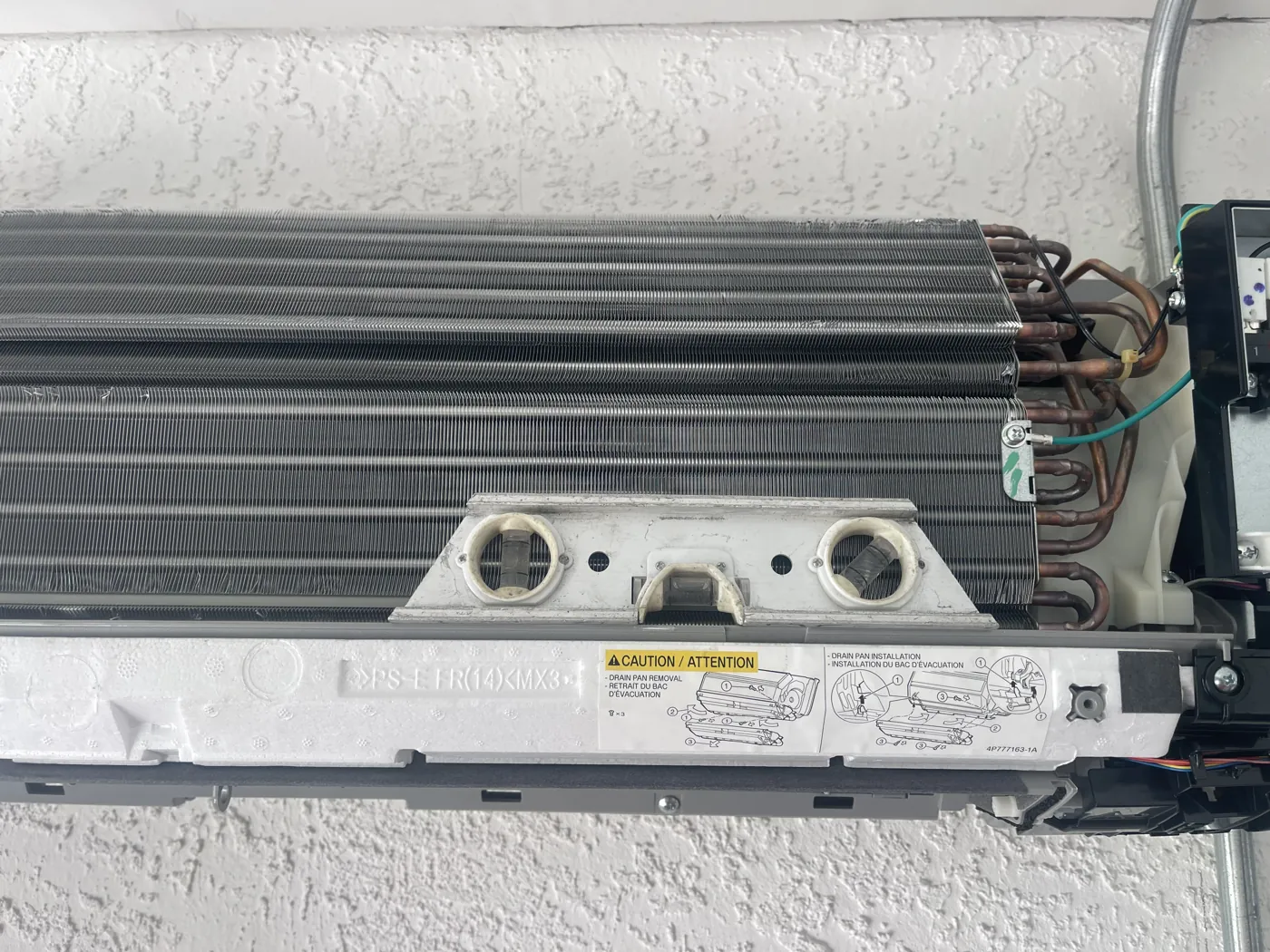
A wall-mounted head condenses water out of the room air onto its coil, the way every air conditioner does, and that water has to go somewhere. Instead of a pan and float switch under an air handler, the head's own shallow tray feeds a slim tube bundled into the line set with the refrigerant lines and the control wire, out through the small wall opening, and down to daylight outside. When that path is pitched wrong, kinked at the wall sleeve, or partly clogged with the same slow algae growth that builds up in any warm, damp drain line, water backs up at the head rather than draining outside.
Most wall heads don't carry the float switch that shuts a central air handler off the moment its pan fills, so a clogged mini-split drain doesn't always stop the system the way a tripped switch would elsewhere in the house. It can keep running and keep dripping, which is how the water ends up tracking down the wall under the head instead of announcing itself right away. Catching it early, before it reaches drywall or flooring, is worth acting on the same day it's noticed.
Where a head sits too low, or too far from an exterior wall for gravity to do the work on its own, that drain runs to a small condensate pump, and a pump that stops running leaves the same wet wall as a blocked tube does. Worth saying on the phone if the head is on an interior wall, because it changes what a technician brings. In the meantime, switching that one head off at its remote stops it making more water while the visit gets scheduled, and the other heads can keep running.
What a Homeowner Can Actually Check First
Before any call, four things are fair game on a mini-split. The drain flush that works on a central system is not one of them, because a wall head has no cleanout tee to flush.
First, the filter. On most heads it's a washable panel that rinses clean rather than a disposable to replace. Second, the remote: its batteries, and whatever mode it's currently set to. Third, one breaker reset, off then back on, then the remote set back to cool to see if it holds. Once, not repeatedly. Fourth, a gentle rinse of the outdoor unit's outside faces, top down, with the system switched off at the remote or thermostat first.
A dirty filter is worth ruling out before anything else, because it touches two of the three problems above: it can choke airflow enough to trigger a fault code, and once it stops catching dust, that dust lands on the coil and washes into the drain with the condensate. None of that requires touching the parts of the head where a fault code, a dead zone, or a stubborn leak actually starts. A refrigerant line, a control board, or the sealed system belongs to a licensed technician every time. Past those four checks, the parts worth suspecting are all behind a cover or under pressure, and that is where the visit starts.
What Happens on the Visit, and What to Have Ready
A mini-split repair visit in Cape Coral, or anywhere else across Southwest Florida, runs in roughly the same order every time, and it isn't the order most homeowners expect. The first thing a technician wants is the symptom happening in front of them, or whatever record the system kept of it. A code that logged three times last week says something a code showing right now does not. Only after that does testing start, and it starts with the least expensive thing to confirm rather than the most likely thing to sell.
Nothing gets named as the failed part until whatever feeds it has been ruled out first. A control board isn't condemned before it's confirmed that power and the communication signal are arriving at that head at all. A drain isn't called clogged before the pitch of the line and its outside end have both been accounted for. On a multi-zone system that usually means one head gets isolated and run on its own, so the shared outdoor unit stops being a variable and the zone is either fine or it isn't. That sequence takes longer to describe than it does to run, and it's the difference between a repair that holds and a part swap that puts the same symptom back on the wall next month.
A few details make that visit shorter. The model number, printed on the head itself or on the outdoor unit. The blink pattern as counted, color included, and whether it repeats or holds steady. When the symptom started, and whether anything changed in the house around then. Whether the filter has been cleaned recently. Anyone in the house can gather that in two minutes, and it's time that doesn't have to be spent gathering it once the truck is in the driveway.
When the Blink, the Cold Zone, or the Wet Wall Means It's Time to Call
Any one of these, a fault code that keeps returning after a filter clean and one breaker reset, a single head that stays dead while its neighbors run fine, or water finding its way onto the wall, has moved past what a homeowner can safely chase down. Guessing at a control board or a pressurized line set doesn't save the visit; it just delays it.
That's the point where mini-split repair from a licensed technician takes over: pulling the stored fault history out of the system, checking the line set under pressure, or tracing which head's control wiring dropped out. The full mini-split guide is the place to start instead if the system itself, not just today's symptom, is the open question.
Blinking Light, Dead Zone, or Wet Wall: Get an Actual Diagnosis
Call or text (239) 350-5234 with the blink pattern, which heads are running, and whether there's water on the wall. Tyler, Guiseppi, or someone from their team will match that against the manufacturer's own legend before naming a part. The service call is a flat $150, and any repair work is quoted upfront before it starts.