
Ductless Mini-Splits in Florida: The Complete Guide
A ductless mini-split solves a specific problem: a room central air never reached or never cooled well, like a converted lanai, a garage, or a bonus room over the garage. One outdoor unit can run a single indoor head or several, each zone holding its own temperature, without adding any ductwork. Sizing is done room by room instead of by a whole-house formula, a single-zone install is usually finished in a day, and upkeep is lighter than a central system since the indoor filter just gets rinsed. This guide walks the full path: deciding if a mini-split fits, sizing it, install day, and living with one afterward.
Where a Mini-Split Actually Solves a Problem
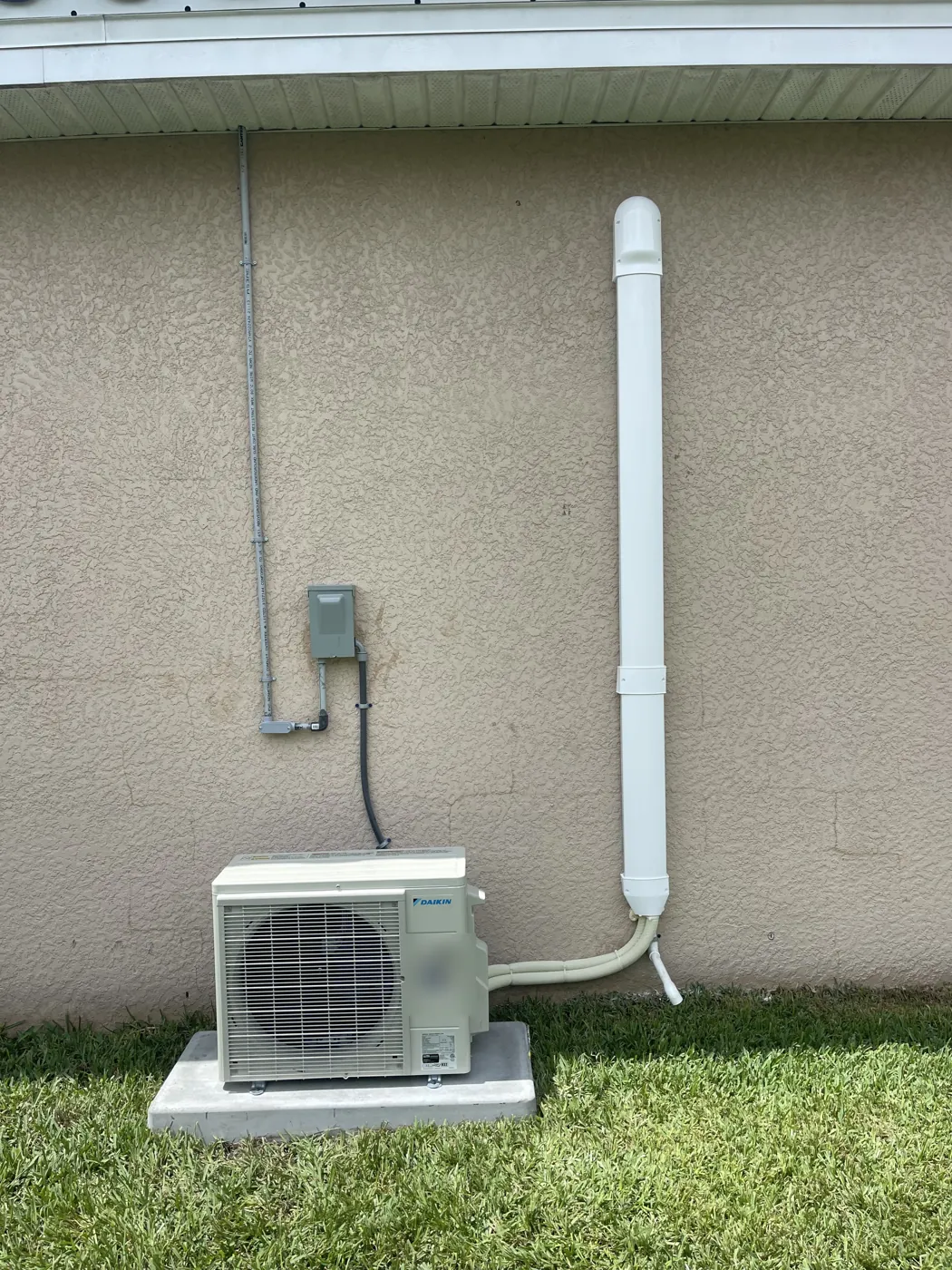
A ductless mini-split earns its keep in one specific situation: a room your central system was never built to reach, or reaches badly. A converted lanai, a garage turned into a workshop or gym, a bonus room over the garage, or an addition built after the original ductwork went in all share the same problem. Running new supply and return ducts to them means tearing into walls, soffits, or an attic that was never sized for the extra load. A mini-split skips all of that: one small line set through an exterior wall, an indoor head in the room, and an outdoor unit within a short run of it. A hot garage is one of the most common cases homeowners call about, and once a garage that never cools down is being used as more than storage, it usually needs real conditioning, not just a fan. A lanai raises a different question first, since a screened lanai is technically still outdoors and no equipment changes that; which lanais can actually be cooled comes down to how enclosed the space really is.
Before committing to a mini-split for one room, it's worth ruling out the smaller, cheaper options first. A window unit can be the right call for a rented space, a wall that can't be modified, or a room used for one season, and how the two actually compare covers where each one wins. A portable unit looks simpler on paper, but most models end up fighting their own exhaust and struggle over a Florida-length cooling season; whether a portable is worth buying walks through why. If the room is one you'll condition for years rather than weeks, a mini-split is usually the more honest long-term answer than either.
How It Actually Works, in Brief
The how-a-mini-split-works answer carries the full mechanism; the short version: one indoor head, one outdoor unit, and a slim line set through a single small wall opening. Refrigerant absorbs heat inside the room and gives it up outside, the same basic process any air conditioner uses, just packaged so the cooling happens right where it's needed instead of traveling there through ductwork.
That's the short version. The full mechanism, including how a single outdoor unit can serve more than one indoor head, is worth reading before you decide on zones. For choosing a system, the part that matters most from here is how many heads you actually need and where.
Single-Zone or Multi-Zone: Matching the System to the House
The simplest setup is single-zone: one outdoor unit paired with one indoor head, both sized for one room. That covers a garage, a converted lanai, or a single bonus room cleanly, with nothing shared or split between spaces. A multi-zone system runs several indoor heads off one outdoor unit instead, each with its own line set and its own control, so one head can hold 72 while another sits at 78 at the same time. How many heads a single outdoor unit can support depends on the equipment, and it's a real question to work through with whoever quotes the job, not something to assume.
Zoning matters more in a Florida house than the brochures let on, because rooms in the same house rarely carry the same heat load. A west-facing bonus room over a garage bakes all afternoon while an interior room stays comfortable on far less effort, and a single shared thermostat can't tell the difference between the two. Separate zones can. That's also why a multi-zone mini-split sometimes ends up fixing one or two problem rooms in a house that otherwise has working central air, rather than being an all-or-nothing decision.
Getting the Sizing Right, Room by Room
Sizing a mini-split is a room-by-room exercise, not a square-footage formula. Ceiling height, how many exterior walls a room has, which direction its windows face, and how much sun the roof or walls take on all change how much cooling that specific space needs. A garage under a west-facing roof deck needs more capacity than a shaded interior bonus room of the same size, even though a generic size chart would treat them the same. Oversizing brings its own problem too: a unit too big for the room cools it fast and shuts off before it's pulled much humidity out of the air, leaving the room cold and clammy at once, an outcome bigger equipment doesn't fix.
That's why a real sizing conversation looks at the specific room instead of guessing from a chart. New installs, mini-splits included, come with a free written estimate, financing available, and the 10-year parts warranty every new install carries here, with an optional 10-year labor warranty available on top of it. Getting the head, the line set, and the outdoor unit matched correctly to the room is what a properly scoped ductless mini-split installation is actually built around, not picking a unit off a spec sheet.
What Installation Day Actually Looks Like
A single-zone install is usually a one-day job. The head goes up first, mounted where it will actually condition the room well and clear of anything that blocks airflow, then a single opening gets drilled through the exterior wall, sized for the line set and nothing bigger. The line set, refrigerant tubing, a control wire, and the condensate drain bundled together, runs from the head to wherever the outdoor unit will sit, on a wall bracket or a small pad with enough clearance to service it later. Once everything connects, the line gets pulled down to a vacuum to clear out moisture and air before refrigerant is released into it, then the whole system gets run and checked before anyone leaves.
A multi-zone job with several heads takes longer simply because there's more of the same work to repeat at each location, not because the process itself changes. Either way, it's a fraction of the disruption a duct addition would cause, since nothing gets torn into the attic, the ceiling, or interior walls beyond that one small penetration per head. The honest caveat: every house is a little different, and an odd line set run or a tight spot for the outdoor unit can add time, which is exactly why a written estimate walks through the specific job beforehand instead of assuming every install looks the same.
Living With a Mini-Split Day to Day
Day to day, a mini-split is simple to live with. Most come with a handheld remote for basic settings, and many models add app or WiFi control for adjusting a room's temperature without hunting for the remote. The indoor head runs quiet, since the loud part, the compressor, sits outside the same as it does on a central system, so a bedroom or home office head is easy to ignore once it's running. It also sits visibly on a wall or ceiling rather than hidden the way ductwork is, worth picturing in the room before installation day, not after.
The zone independence that matters during sizing keeps mattering afterward too. A guest room head can sit off entirely when nobody's using it, while a home office runs however the person working in it prefers, without one thermostat trying to average the two. Most mini-splits also run in reverse to add heat, which covers Southwest Florida's occasional cold snaps without a separate heat source for that one room. That doesn't replace good habits everywhere else in the house, but for the specific room a mini-split serves, it tends to be the most responsive, individually controlled comfort in the house.
Keeping a Mini-Split Running
The indoor head's filter is usually a washable mesh or foam panel that slides out for a rinse rather than a disposable filter to replace, but the cleaning cadence follows the same rule as any Florida filter: every month or two for most homes, closer to every two to four weeks with pets, dust, or a zone running nearly nonstop through summer. Outside, the biggest task is usually just keeping plants and debris clear of the unit, since Southwest Florida landscaping grows fast enough to crowd a condenser within a season if nobody's watching it. The line set, the refrigerant inside it, and anything electrical at either end are not homeowner territory, which is exactly why sealed-system work stays with a licensed technician.
For the parts that do need a professional look, the same coverage applies here as on a central system. The $99-per-visit Annual Comfort Plan, two pre-scheduled visits a year priced per system, covers a mini-split's indoor and outdoor equipment the same way it covers an air handler and condenser. The visit itself runs a ductless-specific checklist, a slightly shorter version of the ducted 34-point inspection, matched to the equipment on the wall. If a zone stops cooling, runs constantly without catching up, or the outdoor unit won't start, that's a $150 diagnostic visit with an upfront quote before any repair work begins, not a guess.
Ready to Map Out Where a Mini-Split Would Go?
Call or text (239) 350-5234. Tyler, Guiseppi, or someone from their team can walk the room with you and put together a free written estimate, sized and zoned for the space instead of guessed at.