
How does a ductless mini-split actually work?
A ductless mini-split works with three connected pieces instead of a network of ducts: an indoor head that blows conditioned air into the room, an outdoor compressor unit, and a slim line set running between them that carries refrigerant, a control wire, and drainage through one small opening in the wall. The same basic heat-moving process any air conditioner uses happens inside that loop. On a multi-zone setup, several indoor heads can run off one outdoor unit, each set to its own temperature.
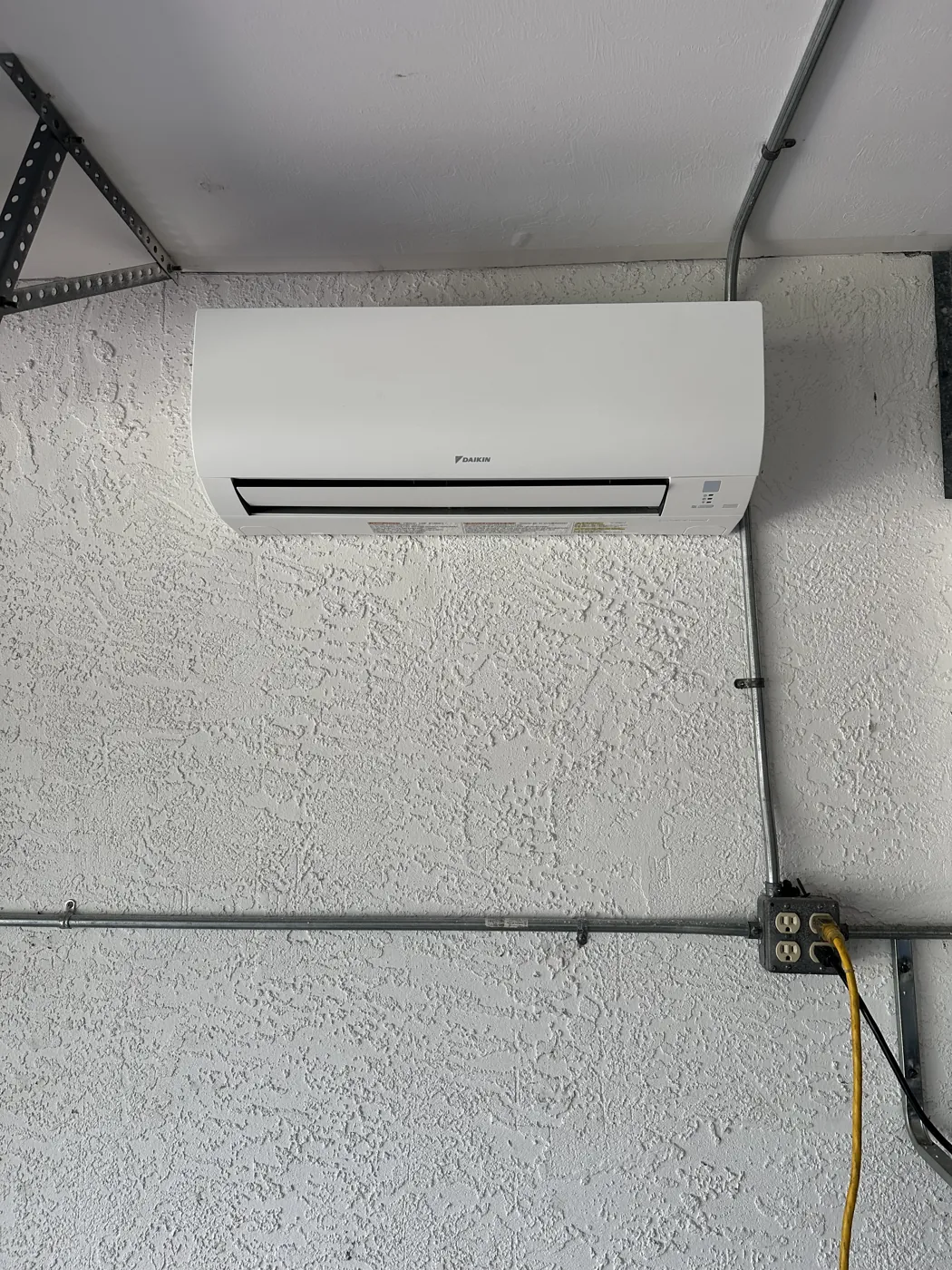
Three Pieces Instead of a Duct Network
The indoor head, mounted high on a wall or set into the ceiling, holds a small coil and fan that blow conditioned air directly into the room. Heads come in a few shapes depending on the room. A wall-mounted head is the most common, a ceiling cassette drops in flush for a more finished look, and a slim ducted air handler can hide above a closet or soffit while still serving just that one zone rather than a whole house. Outside sits the compressor and the outdoor coil, arranged much like a central system's condenser, though often sized and laid out differently, especially once more than one indoor head is connected to it. Between the two runs the line set: refrigerant tubing, a control wire, and a condensate drain, bundled together and passed through a single opening in the wall, usually just a few inches across.
Because that connection is a slim line set carrying refrigerant rather than a duct carrying air, there's no need to route sheet metal or flexible ductwork through walls, attics, or ceilings to get conditioned air where it's needed. That single difference is the entire reason a mini-split can reach a space the original ductwork never got to, without tearing into walls or ceilings to add it.
Same Refrigeration Idea, Just Repackaged
Inside that loop, a mini-split is moving heat the same way any air conditioner does: refrigerant absorbs heat from indoor air at the head's coil, and the compressor raises its pressure and temperature before sending it outside, where the outdoor coil hands that heat off to the outside air before the refrigerant heads back in to pick up more. The physics isn't the interesting part here. The packaging is.
Instead of one central coil pushing cooled air through a network of ducts to reach every room, a mini-split puts a small coil-and-fan combination directly in the room being conditioned. Nothing has to travel through a hot attic before it reaches a vent. That also means a single-zone mini-split only conditions the room or open area where its head is actually mounted, unlike a central system's one indoor coil feeding an entire house through branching ductwork. Reaching a second space means adding a second head, which is where zone logic comes in.
Zone Logic: How One Outdoor Unit Runs Several Rooms Differently
A single-zone system serves one room. A multi-zone system runs several indoor heads off that same outdoor unit, each with its own line set back to it. How many depends on the equipment and the spaces involved, which is why a multi-room ductless layout is a realistic whole-house option and not just a one-room fix. Just as important, each head has its own control, so one room can sit at 72 while another runs at 78, at the same time, off shared outdoor equipment.
That's possible because the compressor in most modern mini-splits is variable-speed, meaning it can ramp its output up or down to match what's actually being asked of it moment to moment, instead of simply switching fully on or fully off. When only one of three connected zones is calling for cooling, the system can lean its effort toward that zone rather than running at full output for the whole loop. That's a meaningfully different control logic than a central system's single thermostat deciding for an entire house at once.
What Actually Gets Installed, Room by Room
From an installation standpoint, this means mounting a head where it will actually condition the room well, clear of obstructions and placed for good airflow, drilling one small opening in the wall for the line set, and setting the outdoor unit somewhere with clear space around it, not routing ductwork through the attic at all. The outdoor unit itself typically sits on a small wall bracket or a pad at ground level, wherever it can get steady airflow and still leave room to service it later.
Getting the sizing and placement right for each zone is what a proper ductless mini-split installation is built around: matching the head and line set to the room, instead of treating every space the same way.
Have a Room Central Air Can't Reach?
Call or text (239) 350-5234. Tyler, Guiseppi, or someone from their team can look at the space and walk through exactly how the heads, line set, and outdoor unit would lay out.