
Air Filters: The Complete Florida Homeowner's Guide
An AC filter looks like the simplest part of the whole system, and it gets treated that way, ignored until the vents look dusty. It shouldn't be. Every decision around it, fiberglass or pleated, what MERV number, what size, which direction, how often, traces back to one tradeoff: how much a filter catches versus how easily air can still get through it. This guide walks through all five decisions as one connected argument instead of five separate questions, so the filter someone buys actually matches the system it's protecting.
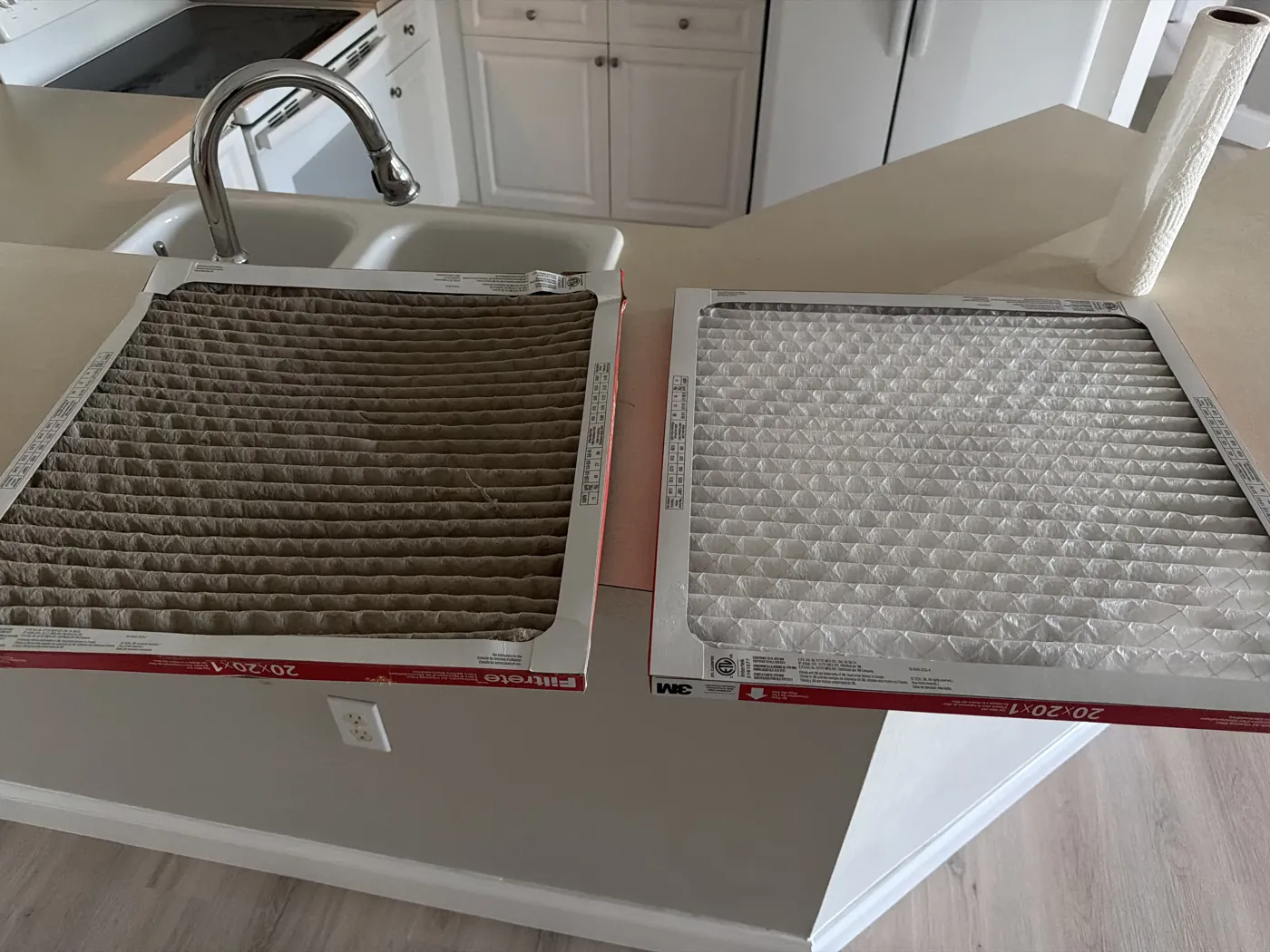
The Small Part Doing More Work Than It Looks Like
A filter is a few inches of pleated paper or fiberglass sitting in a slot most homeowners couldn't point to without looking. It gets almost no attention until someone notices dust on the vents or a system that seems to be working harder than it used to. That order of attention is backwards. Every bit of air an AC system cools has to pass through that filter first, on its way to the coil and blower that do the actual work of moving heat out of a house.
The individual questions around a filter, which type, what rating, what size, which way it faces, how often to swap it, each have their own straightforward answer. What ties them together is less obvious: they're really all versions of the same tradeoff between catching more debris and letting air move freely, and getting one piece right while ignoring the rest still leaves a filter working against the system instead of for it.
What a Filter Is Actually Protecting
It's easy to assume a filter's whole job is keeping the air a household breathes cleaner, but its first responsibility is narrower than that: protecting the equipment behind it. Dust and debris that get past a bad or missing filter don't just circulate through the house, they settle on the evaporator coil and build up on the blower wheel, the two parts most responsible for actually cooling and moving air. A coil coated in dust insulates itself against the airflow that's supposed to pull heat off it, and a dirty blower wheel spins less efficiently the longer it goes unchecked.
Catching household dust and allergens along the way is a real benefit, not a myth, but it's a secondary effect of a filter doing its primary job well, not a guarantee of clean indoor air on its own. A filter that's the wrong type, size, or schedule for a home falls short on both fronts at once, protecting the equipment less and catching less of what circulates through the rooms.
Florida's runtime makes that protection matter more than it would somewhere with a short cooling season. A system that runs most of the year is pulling air across the coil for a lot more hours than an identical system somewhere with a mild spring and fall, and every one of those hours is another chance for a weak or clogged filter to let something through. Humidity adds its own wrinkle: damp air tends to hold and clump debris more than dry air does, so a filter here is often working against a heavier load than the same filter would face in a drier climate.
MERV: A Scale That Isn't Simply Higher Is Better
Nearly every filter box carries a MERV number, and it describes one specific thing: how much of the debris moving through the filter actually gets trapped, tested across a range of particle sizes rather than just the largest ones. A bigger number is tempting to read the way a bigger screen size or a bigger engine reads, as a straightforward upgrade. Filtration doesn't work that cleanly.
That tradeoff is the real story behind a MERV number: catch more, and you ask more of the blower pushing air through it. What a MERV rating actually measures breaks down that scale in full. A number alone doesn't say which side of the tradeoff a given house can actually afford, that depends on what's pushing the air on the other side of it.
Newer systems with variable-speed blowers can adjust and compensate for some of that added resistance on their own, ramping up to keep airflow steady even with a denser filter installed. Plenty of homes, especially older ones with a single-speed blower, don't have that flexibility built in, so the same upgrade that helps one house handle a higher rating comfortably can leave another one straining against it.
Fiberglass, Pleated, or the Middle Ground
At one end of the shelf sits basic fiberglass: thin, inexpensive, and easy for air to pass through, but built to catch mostly the largest particles while finer dust slips right past it. At the other end sit dense, high-filtration pleated filters that catch far more but ask considerably more of the blower pushing air through them. Neither extreme is wrong for every situation, but neither is a safe default either.
For most Florida homes, especially systems that have been running a while, something between the two extremes tends to be the safer default, catching meaningfully more than basic fiberglass without asking more of an older blower than it was built to handle. Reaching for the top of the shelf because it sounds like the safer, more protective choice can quietly work against a home if the equipment underneath was built around something lighter. Which filter type actually fits a Florida home works through that call by system age, since a newer variable-speed blower can absorb more of that tradeoff than an older single-speed one.
Washable filters are a separate category worth knowing about too, cleaned and dried on a set interval instead of thrown away, though a filter put back in before it's fully dry can cause its own problems. Whichever category a filter falls into, the same underlying tradeoff between catching more and blocking more air applies to it just the same.
Getting the Physical Fit Right
A filter that doesn't seal against its frame doesn't stop air from moving, it just lets some of that air route around the media instead of through it, carrying dust straight past the filter toward the coil. Where that filter actually sits varies from house to house, too. Some homes pull return air through a single grille set in a hallway wall or ceiling. Others feed it through a slot built directly into the air handler cabinet, and larger homes sometimes have more than one rack to keep track of, the easiest one to neglect being the second or third that nobody remembers having.
How to find the right filter size covers reading the frame, measuring a rack, and why a slightly wrong size on paper causes a real problem in practice.
The Arrow Nobody Checks
A small printed arrow on a pleated filter's frame points toward the air handler, not back toward the room, and installing it backward doesn't stop air from moving through the system, so the mistake rarely announces itself right away. What it costs is quieter: filtration drops and the pleats hold up less well over time. Which direction an air filter goes in covers what changes when it's backward and what to do when the arrow's too worn to read.
How Often, and Why the Box Undersells Florida
Most Florida homes should plan on changing a standard filter every month or two, and every two to four weeks with pets, heavy dust, or a system running nearly nonstop through the hottest stretch of summer. Runtime drives that number more than the calendar does, and Florida systems run more months out of the year than the printed interval on most filter boxes assumes.
How often to change an AC filter in Florida covers how to judge it by looking at the filter itself rather than counting weeks, and what changes that schedule for a given household.
The One Filter Habit That Actually Works
Type sets the tradeoff, MERV measures it, fit determines whether the filter does its job at all, direction determines whether it holds up over time, and runtime sets the clock on all of it. Five separate decisions, but really one underlying question every time: is enough clean air reaching the coil without asking more of the blower than it was built to handle.
A homeowner can handle the filter itself from start to finish: checking it, buying the right size, sliding it in facing the correct way. What's harder to see without the equipment open is whether the system behind that filter was ever built to handle what's currently sitting in the rack, and whether the coil and blower it's protecting are actually staying clean. That's part of what gets looked at during an AC maintenance visit, alongside the rest of the 34-point check twice a year that this whole filter decision quietly leans on.
Not Sure Your Filter Matches Your System?
Call or text (239) 350-5234. The $99-per-visit Annual Comfort Plan brings a technician out twice a year to check the coil and blower a filter can't reach on its own.