
What does refrigerant actually do in my AC?
Refrigerant is the fluid that actually moves heat out of your house: it soaks up heat by evaporating into a gas indoors, then gives that heat back up by condensing into a liquid outdoors, cycling through a sealed loop again and again. It isn't a fuel, and normal operation doesn't use it up. A system that needs refrigerant added year after year isn't consuming it like a car burns gas, it's leaking it, and adding more without finding that leak only buys another year before the same problem comes back.
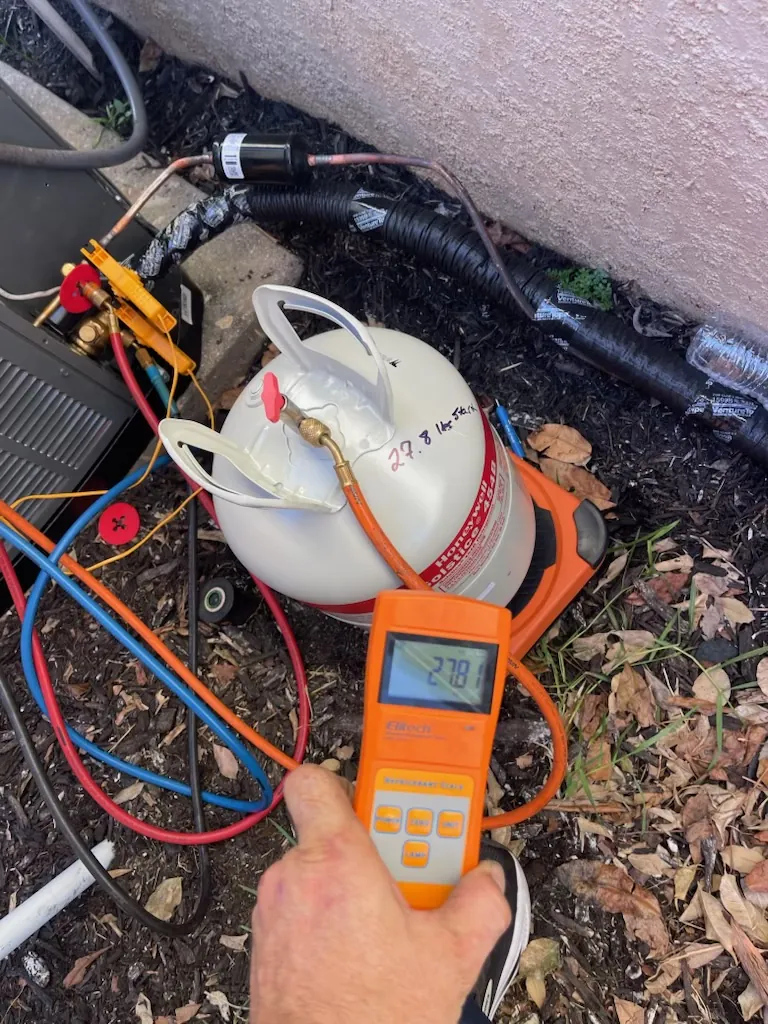
Heat Moves Because Refrigerant Changes State, Not Because It's Cold
Refrigerant does its job by switching back and forth between liquid and gas, and that switch is where all the actual work happens. Turning from a liquid into a gas takes in heat. Turning from a gas back into a liquid gives that same heat back up. Refrigerant is engineered to make that switch at a low temperature, so it can happen using nothing more than the warmth already sitting in your house.
A fogged-up bathroom mirror after a hot shower runs on the same idea, just in reverse. Steam is water that absorbed enough heat to become a gas, and when it hits the cool glass, it gives that heat back up and turns to liquid again, right there on the mirror. Refrigerant does the same thing on a loop, over and over, all day long, just at a temperature engineered to work with ordinary room air instead of a hot shower.
That's the heart of it: a fluid that changes state at a workable temperature, with the compressor and the metering device using pressure to control where it boils and where it condenses. Nothing about that requires refrigerant to run out, disappear, or get replenished the way fuel does.
A Sealed Loop Doesn't Consume What's Inside It
Think about the difference between refrigerant and gasoline. Gasoline burns. It changes into something else entirely and is gone, which is exactly why a car needs more of it. Refrigerant never burns and never changes into another substance. It just moves between liquid and gas, again and again, inside copper lines and coils that are sealed shut.
As long as that loop stays sealed, the same refrigerant your system started with keeps circulating for the system's entire working life. Nobody should need to add refrigerant to a system that's holding pressure the way it's supposed to, any more than a sealed water bottle needs topping off. It isn't a fluid that gets used up by running the system. It's a fluid that gets lost when the seal fails.
Why 'It Just Needs a Top Off' Is Never the Whole Story
This is the part worth remembering: a system that's low on refrigerant isn't low because it used some up doing its job. It's low because refrigerant is escaping somewhere in that sealed loop, through a small crack, a worn fitting, or a pinhole in a coil. Adding refrigerant without finding and fixing that leak treats the symptom and leaves the actual hole exactly where it was.
That's also why a system that needed a recharge last year and is asking for one again this year isn't unlucky. It's telling you the same leak, or a new one, is still there. Finding where refrigerant is actually escaping takes pressure testing and specialized equipment, not a guess, which is exactly why this isn't a homeowner project. Refrigerant work on a sealed system is a job for a licensed technician, not something to troubleshoot on your own.
Not Every System Runs the Same Refrigerant
One more thing worth knowing: the refrigerant inside an older system is often a different chemical blend than what a newer system uses. They aren't interchangeable, and a technician has to know which one a given system was designed around before touching it. That's part of why the make and age of your equipment matter as much as the symptom you're calling about.
If your system is older, that's not a reason to panic. It's a reason to get a straight answer about what your specific unit needs rather than assuming it works the same as the system next door. If your AC keeps asking for refrigerant, that's a conversation for AC repair, not another top off.
Refrigerant Low Again This Year?
Call or text (239) 350-5234. Exclusive Cooling Solutions will find where it's actually escaping instead of just adding more and hoping, with an upfront quote before any repair begins.