
What does an AC capacitor do, and why do they fail in Florida?
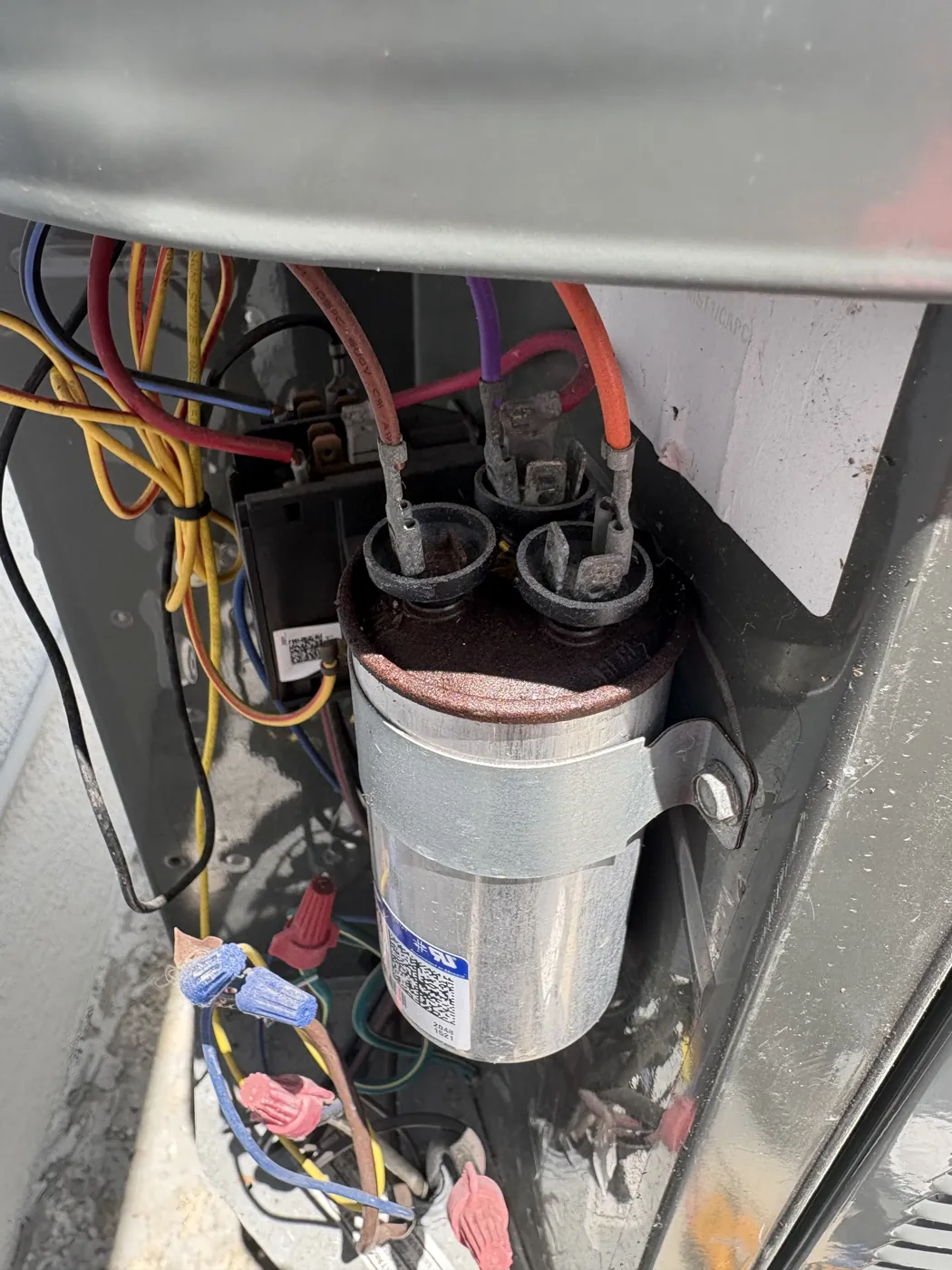
An AC capacitor is a small electrical component that stores a charge and releases it in one push, giving the compressor and fan motor enough force to start turning, then a steadier boost to keep them running. Capacitors fail more often in Southwest Florida than in milder climates because they sit through more heat from more directions at once: direct sun on the outdoor cabinet, a cooling season that barely lets up, and the compressor's own operating heat, all working on the same small part.
Two Jobs, One Small Component
A capacitor's first job is starting. An electric motor sitting still, whether it's the compressor or the outdoor fan, needs more electrical force to begin turning than it does to keep turning once it's already moving, the same reason pushing a stalled shopping cart takes more effort than keeping it rolling. The capacitor supplies that extra push in the first second or two of a cooling cycle, then keeps assisting once it is turning.
Its second job is running. Most residential outdoor units use what's called a dual run capacitor, a single canister with two separate sections wired to assist both the compressor and the fan motor continuously while they operate, not just at startup. That ongoing assist helps both motors draw power efficiently for as long as the system is cooling. One small part, two motors, two jobs. When it's working, you never notice it. When it isn't, both motors it supports are affected at once, which is why a single failing capacitor can take down cooling entirely instead of just slowing one piece of it down.
Heat Soak: Why the Part Wears Down Instead of Just Breaking
A capacitor doesn't usually fail out of nowhere. Inside that metal canister the charge sits across layers separated by an insulating fill, and heat breaks that fill down over time, slowly and cumulatively, the same way a battery left in a hot car loses its punch faster than one kept somewhere cooler. Every hour spent at a higher operating temperature adds a small amount of wear, and that wear doesn't reverse itself between cooling cycles.
That's why a capacitor's decline shows up as a gradual weakening rather than a clean on-off failure. It keeps working, just with less reserve capacity, until one hot afternoon it can no longer deliver the push a motor needs to start. By the time that happens, the part has usually been quietly losing strength for months.
Why Southwest Florida Runs Through Capacitors Faster
Heat soak happens everywhere capacitors are used. It just happens faster here, for a few reasons that stack on top of each other. The outdoor unit sits outside, often in direct sun, so its own cabinet runs hotter than the surrounding air on a summer afternoon. The compressor running inside that same cabinet adds its own heat on top of that, since it's a working motor generating warmth of its own with every cycle, not a passive box. Add a cooling season that barely lets up, with the system cycling on and off through most months of the year instead of a few, and that capacitor spends far more total hours at high operating temperatures than the same part would in a milder climate.
None of that makes a capacitor a poorly made part. It means it's a wear item, built to a normal working life under normal conditions, and Southwest Florida's conditions simply aren't average. That's the honest reason capacitors top the list of parts replaced on a residential system here: not a defect, not bad luck, heat above all doing what heat does to that particular component faster than it does to most other parts in the cabinet.
Why This One Stays a Technician's Job
A capacitor keeps an electrical charge inside it even with the system fully powered down, which is different from most parts a homeowner might reasonably check, like a breaker or a thermostat battery. That stored charge is exactly why this part isn't a homeowner project at any stage, not testing it, and not opening the cabinet it lives in to look.
The fix itself is usually quick once a technician confirms a capacitor is actually the problem rather than a motor or a wiring issue further along the same circuit. A licensed AC repair visit starts with an upfront quote and a $150 service call, so you know the cost before anything gets replaced.
Think a Capacitor Might Be on Its Way Out?
Call or text (239) 350-5234. Tyler, Guiseppi, or someone from their team can test it safely and give you a straight answer, with an upfront quote before any repair begins.