
Can I check my AC's refrigerant level myself?
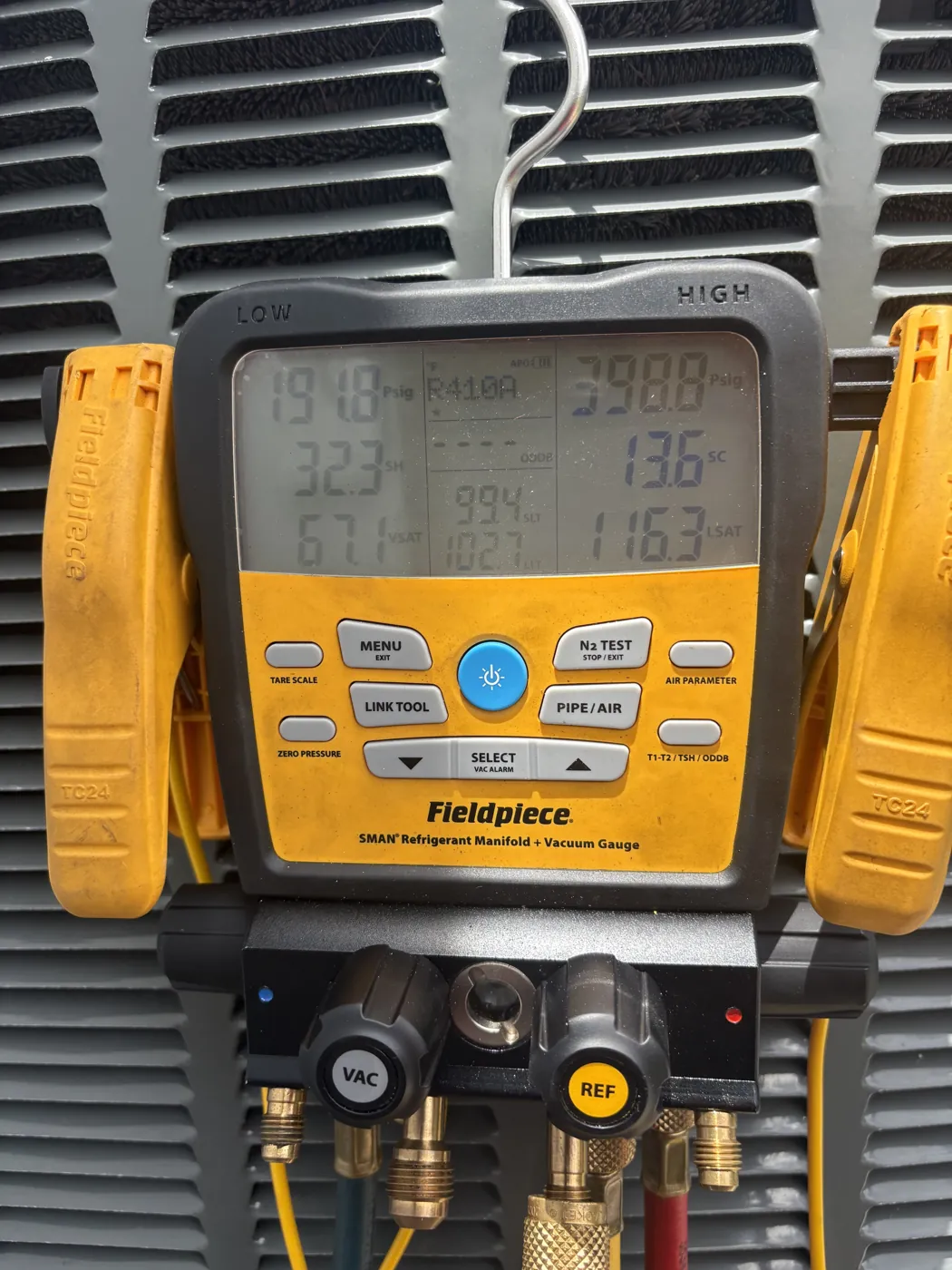
No. Checking refrigerant means connecting gauges to sealed service ports and reading pressure against a target that shifts with the outdoor temperature and the specific system, work that requires an EPA-issued refrigerant handling certification most homeowners don't have. What you can check yourself are the things that mimic a low charge: a dirty filter starving the coil, ice already sitting on the line, and the breaker, reset once. Ruling those out first is the useful, honest part of this question.
Refrigerant Doesn't Get Used Up the Way Gas or Oil Does
It's an easy assumption to make. A car needs more gas eventually. An engine needs its oil topped off on a schedule. So it feels reasonable to picture refrigerant the same way, something that gradually runs low with normal use and needs a top-up now and then. An air conditioner doesn't work like that. Refrigerant is sealed into a closed loop when the system is installed, and a healthy system keeps that exact same charge for its entire working life, often well past a decade, without ever needing more added.
That's why a low reading is never routine. If gauges show a system short on refrigerant, it didn't evaporate or burn off through ordinary use. It escaped, through a leak somewhere in a coil, a line, or a fitting that was never supposed to let it out. Low refrigerant is a symptom of that leak, not the problem itself, which is also why simply adding more without finding where it went tends to solve nothing. The new charge leaks out the same way the old one did.
Nobody tops off a car's air conditioning every spring the way they check tire pressure, and a home system runs on the same principle. If yours needs refrigerant, something let it go, and finding that something matters as much as replacing what's missing.
What a Gauge Actually Measures, and Why It Takes a License to Use One
Checking that sealed loop means connecting a manifold gauge set to service ports built into the system, one on the high pressure side, one on the low pressure side, and reading what each one shows. That alone takes equipment most households don't own, but the harder part isn't owning a gauge set.
A pressure reading only means something once you know the target for that exact refrigerant type, that exact system, and the outdoor temperature at that exact moment, since the correct range shifts as conditions do. A number that's perfectly normal on a mild afternoon can flag a real problem on a scorching one. Reading it correctly takes training and a chart specific to that equipment, not a gauge and a guess.
Buying, connecting to, or recovering refrigerant also requires an EPA-issued Section 608 certification. That's a federal requirement, not a rule any HVAC company invented, and it exists because refrigerant is regulated and isn't allowed to simply vent into the air. That's also why those service ports stay off-limits, similar to a breaker panel's internals or a capacitor: not because the fitting looks complicated, but because what's inside is pressurized, regulated, and easy to get wrong without training.
The Three Things Worth Ruling Out Before You Assume Refrigerant
A lot of what feels like low refrigerant from the living room, weak cooling, warmer air than usual, a system that won't keep up, has other, more common explanations. Before assuming the hard answer, it's worth ruling out the easy ones yourself.
Start with the filter. A clogged filter starves the coil of airflow, and a coil that isn't getting enough air across it cools poorly and can run colder than it should, which mimics a lot of what a low charge looks like from the thermostat. Pull it and check it against a window. Most Florida homes need a fresh one every month or two, sooner, every 2 to 4 weeks, with pets, dust, or a system running nearly nonstop through summer.
Ice changes the question entirely, since the cause splits into two very different repairs from there. If you're already looking at ice on the copper line or the coil, skip straight to protecting the system. Switch your thermostat to off (not just up) to protect the system if it's frozen or struggling. Give it time to thaw before anyone touches it again.
And if the system isn't running at all, that's not a refrigerant question yet either. Low refrigerant shows up as reduced performance while a system runs, not as a total failure to start. Check the breaker once: switch it fully off, then back on, then set the thermostat back to cool and see if it holds. If it trips again right away, that's an electrical fault, a separate problem from anything in the sealed side of the system.
When the Easy Answers Don't Explain It
If the filter's clean, there's no ice anywhere, and the breaker's holding steady, but the system still isn't cooling the way it should, running long stretches without catching up, or blowing air that never gets as cold as it used to, that combination is worth a real diagnosis instead of more guessing.
That's exactly what a proper AC repair visit is built for: a licensed technician connects the gauges, reads the pressures against the right target for your system and the day's conditions, and tells you plainly whether refrigerant is even the issue before anything gets added, recovered, or charged.
Exclusive Cooling Solutions is a fully licensed, fully insured Cape Coral contractor, FL License CAC1823575, and a repair visit starts with a $150 service call and an upfront quote before any work begins, so you know what you're paying for and why.
Suspect Low Refrigerant? Get an Actual Reading, Not a Guess
Call or text (239) 350-5234. Tyler, Guiseppi, or someone from their team can connect real gauges and give you a straight answer, with an upfront quote before any repair work starts.