
What is an evaporator coil, and why does it matter?
The evaporator coil is the part of your air conditioner where cooling actually happens: a finned coil inside the air handler that cold refrigerant flows through, pulling heat and humidity out of the air your blower pushes across it. It matters because a coil that's dirty, damaged, or leaking refrigerant can't do that job well, no matter how strong the rest of the system is. Coils can develop pinhole leaks over time, and not every damaged coil is worth cleaning instead of replacing.
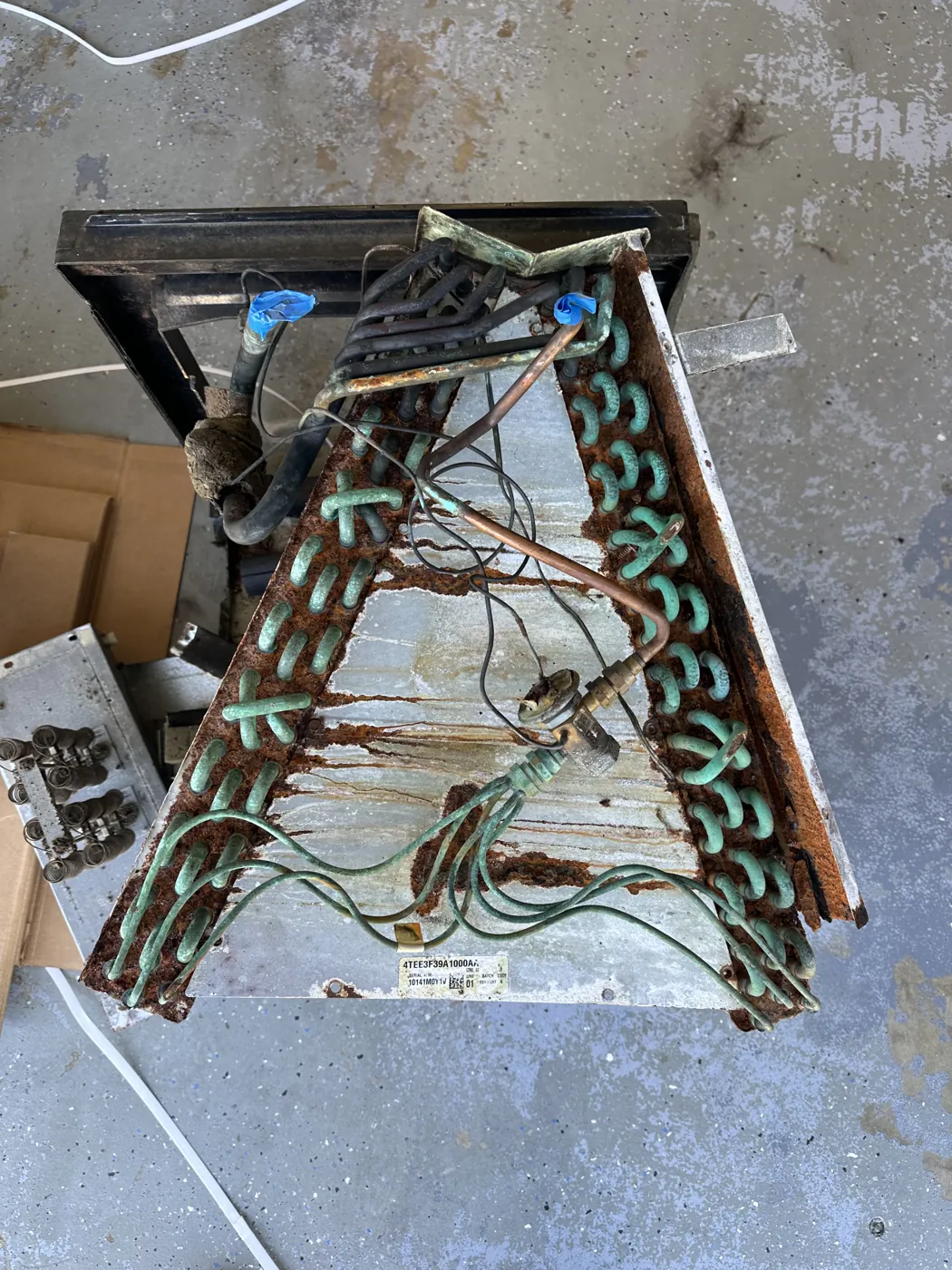
The Coil Itself: What's Actually Inside the Air Handler
Inside most air handlers the evaporator coil is shaped like a shallow A-frame or a flat slab: a maze of thin copper tubing threaded through row after row of aluminum fins, sitting directly in the path of the air your blower moves through the house. It looks unremarkable, almost like a small car radiator turned on its side, but it's the one component in the entire system where cooling actually happens. The compressor outside, the ductwork, the thermostat on the wall, all of it exists to support what happens at this coil.
Cold liquid refrigerant enters the coil and changes into a gas as it travels through the tubing, and that change of state is what lets it pull heat out of the air blowing across the fins. The aluminum fins are there purely to add surface area, since bare copper tubing alone wouldn't have nearly enough contact with the passing air to pull much heat out of it. Moisture in that air condenses on the cold fins at the same time, which is why a coil in Florida stays damp for hours after the system shuts off.
Why This Coil, Specifically, Develops Leaks
Unlike the outdoor condenser, which battles rain, sun, and along the coast, salt in the air, the indoor coil sits inside a closed cabinet where weather never reaches it. Its damage tends to come from a quieter source: the air of the house itself. Ordinary household chemistry, fumes off-gassing from new carpet, cabinetry, cleaning products, and paint, can react with moisture sitting on the coil's cold copper surface over months and years, slowly etching pinhole leaks into the tubing from the inside out. Technicians sometimes call this formicary corrosion, since the tiny tunneled leaks it leaves behind resemble a trail of ant tunnels across the copper.
Plain age plays a role too. Copper tubing that's expanded and contracted through thousands of cooling cycles over ten or fifteen years is simply more likely to develop a weak spot than tubing installed last year, and a coil with a manufacturing flaw can leak far earlier than that. A coil can look clean and intact from the front of the air handler even while a leak is slowly forming somewhere inside a bend in the tubing, out of sight until the system is noticeably low on refrigerant.
Dirty Is Fixable. A Leak Usually Isn't.
A coil that's simply dusty, coated in the fine household debris that settles on anything with constant airflow moving across it, can often be cleaned by a technician and brought back close to its original performance. A light coating acts like a blanket, insulating the fins and making the coil measurably worse at pulling heat and moisture out of the air, but the coil underneath is usually still sound once that layer is gone.
A leak is a different situation entirely. Refrigerant doesn't get consumed the way fuel does, so a system that's low on it lost that refrigerant somewhere, and a leaking coil can't be patched back into a reliable, long-term fix the way a dirty one can be restored by cleaning it. Depending on the coil's age and how the rest of the system is holding up, the honest answer is sometimes to replace just the coil, and sometimes to weigh that cost against replacing the whole indoor and outdoor pairing at once. That's a conversation worth having with a technician looking at your specific coil, not a rule of thumb that fits every one the same way.
What a Routine Inspection Checks, and What It Doesn't
Our $99-per-visit Annual Comfort Plan includes two visits a year, each built around a 34-point inspection of the air handler and condenser, and the indoor coil is part of that checklist both times. Three separate points on the list land on this one component: its fins and overall condition, whether anything is restricting it, and cleaning its surface. A technician also watches for the kind of frost or moisture pattern that hints at an airflow or refrigerant problem, and flags anything that looks like the early stages of a leak.
That cleaning point carries a condition, and the condition matters: the surface gets cleaned if it is accessible and not impacted. A light film wiped off a reachable coil face is routine work on the visit. Pulling the coil, or deep-cleaning one that buildup has packed solid, is not, and we don't quote it as though it were. When an inspection turns up a coil that needs that deeper cleaning, or a coil that's leaking rather than dirty, it becomes its own AC repair visit with a clear, upfront quote, not a surprise add-on to a routine appointment.
Wondering What Shape Your Evaporator Coil Is In?
Call or text (239) 350-5234 to get the indoor coil actually looked at, not just assumed fine. A $150 service call comes with an upfront quote before any repair work starts.