
Why does my smart thermostat need a C-wire?
A smart thermostat needs a C-wire, short for common wire, because it draws continuous low-voltage power to run its screen, Wi-Fi radio, and internal processor. An old mechanical or basic battery thermostat never needed one, since it only used power in short bursts to flip a switch on and off. Many homes, especially older ones, were originally wired with just four wires and no spare C-wire waiting behind the wall, which is the most common snag when installing a smart thermostat.
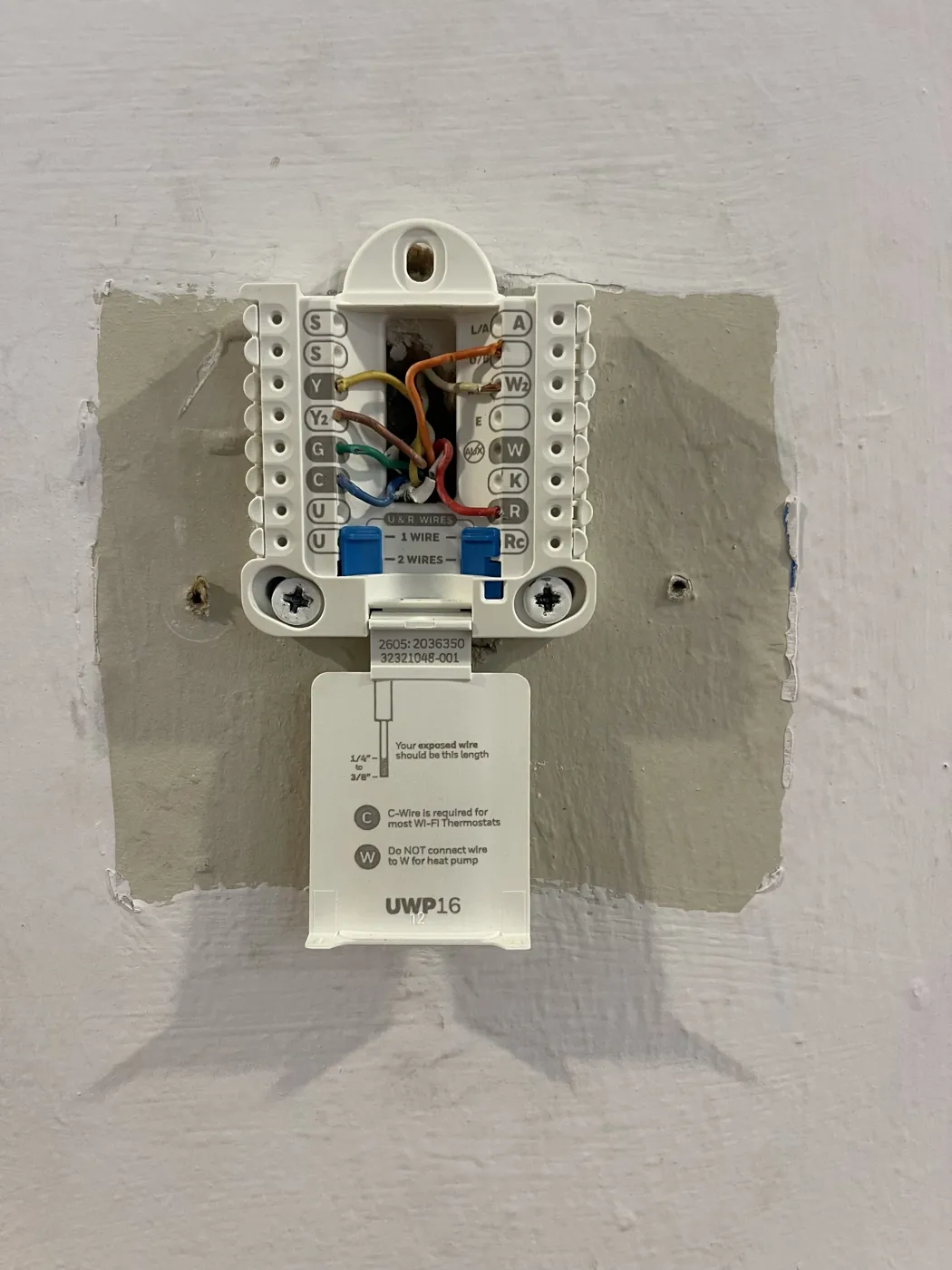
What the 'C' in C-Wire Actually Means
Every thermostat wire has a job. R carries power from the transformer, Y calls for cooling, W calls for heat, and G runs the fan, with O or B added on a heat pump system to tell the reversing valve which direction to run. The C-wire, short for common, completes the electrical circuit and provides constant, uninterrupted power back to the thermostat itself, rather than to the equipment it's controlling.
That distinction matters. The call wires, Y, W and G, only do anything while the thermostat is actively asking for cooling, heat or the fan. R is live all the time, but on its own it is only half a circuit, and the C-wire is the return path that closes it. The C-wire is different. It's live all the time, which is exactly what a device with a screen, a Wi-Fi radio, and a processor running in the background needs in order to stay connected and responsive around the clock, not just while it's calling for cooling. Put every wire together and a fully wired smart thermostat setup often runs five conductors instead of four, a small difference on paper that turns out to be the one most often missing behind an older wall plate.
Why Decades of Older Thermostats Never Needed One
A basic mechanical thermostat, the kind with a dial or a simple digital display and no app, barely uses any power at all. It's essentially a switch: it senses temperature, closes a connection to call for cooling or heat, then opens it again once the house reaches the set point. That kind of simple on-off switching can run for years on small batteries or brief pulses of power alone, with no need for a dedicated, always-on wire.
When HVAC systems were wired years ago, installers ran only the wires that setup actually needed, often four of them. Nobody was wiring homes for thermostats with color touchscreens and home Wi-Fi at the time, because that equipment didn't exist yet. A perfectly functional four-wire setup from years back simply has no reason to include a wire nobody needed when it was installed, and there was nothing wrong with the job the installer did. It was correct for the equipment it was built to run.
The Retrofit Snag: Reaching Behind the Old Thermostat
This is where a lot of smart thermostat installs hit a wall, sometimes literally. The expectation is a spare wire capped off and waiting behind the plate, and in plenty of homes, especially older ones, there simply isn't one. Every wire behind the plate is already doing a job, with nothing extra left to press into service as a common wire.
Some smart thermostat manufacturers sell a small adapter, sometimes called a power extender kit, that lets a thermostat borrow power without a dedicated C-wire in certain system configurations. Whether that works, or works well, depends on the specific HVAC equipment and wiring already in the home, and it isn't something to assume will work by just trying it. A simple single-stage air conditioner is more likely to tolerate a workaround like that than a heat pump or multi-stage system, where the thermostat is already juggling more signals at once. Guessing wrong can leave a thermostat that reboots randomly, drops off Wi-Fi, or in some setups, affects how the connected equipment behaves.
Why This Is a Call, Not a DIY Project
Getting a true C-wire in place usually means running a new low-voltage wire from the air handler to the thermostat, which often means fishing wire through a wall, an attic, or a closet, or opening the control board inside the air handler to confirm what's available and connect it correctly. That's electrical work around a live control board, and it's not a place to start improvising with wire nuts and a best guess.
If a smart thermostat you're installing doesn't have the wire it wants, the safest move is to stop and call rather than force a workaround. A licensed AC repair technician can confirm what's actually available behind your wall, run a proper C-wire if the system needs one, and make sure the thermostat is talking to your specific equipment correctly the first time. For someone who does this routinely, it's a straightforward visit, and it heads off the longer-term headache of a smart thermostat that never quite behaves after a rushed workaround.
Installing a Smart Thermostat and Missing a Wire?
Call or text (239) 350-5234. Tyler, Guiseppi, or someone from their team can check your wiring and get a smart thermostat connected the right way, C-wire included if it needs one.