
What does the blower motor do, and how do I know it's failing?
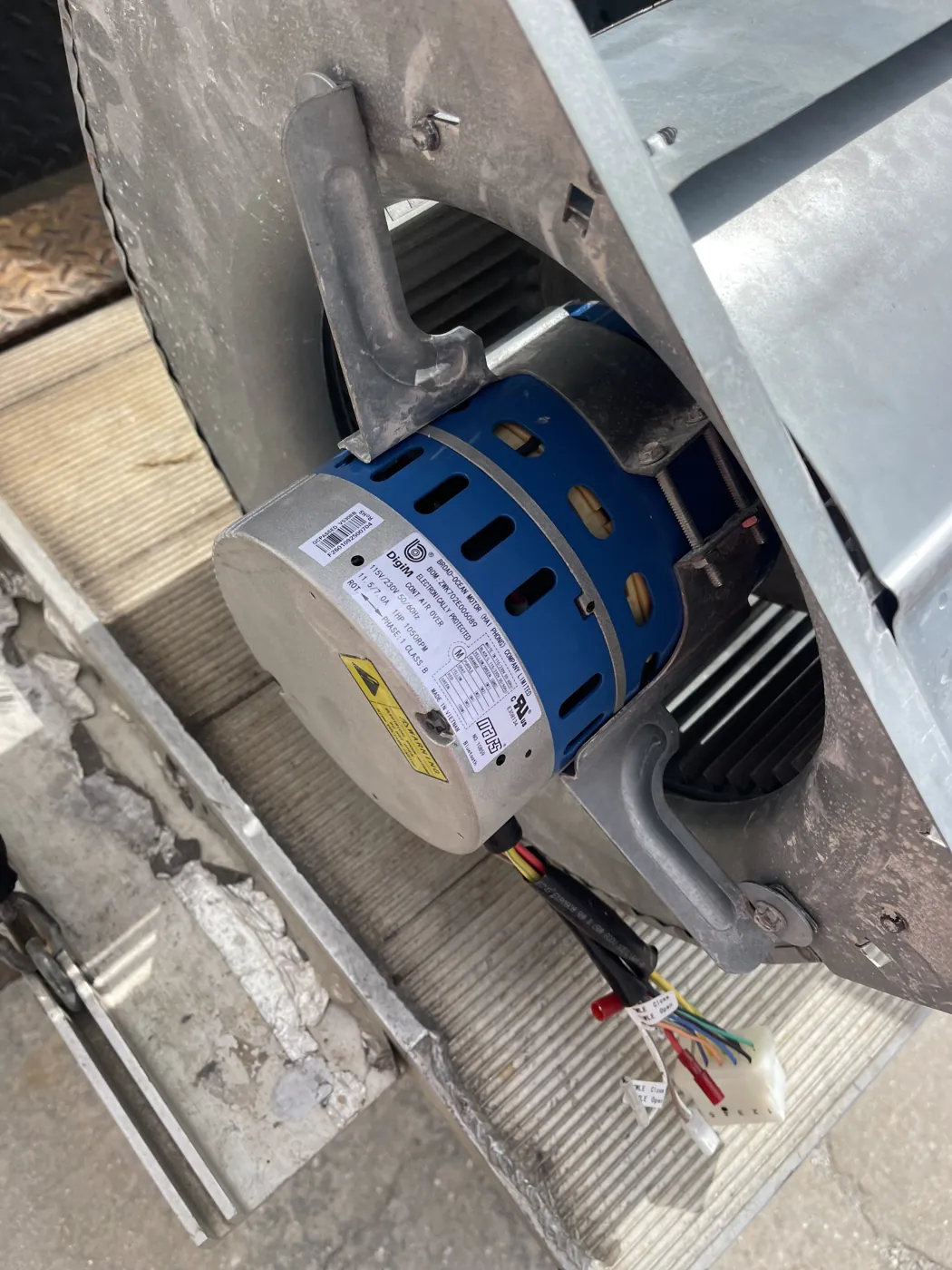
The blower motor is the fan inside your air handler that pulls house air through the return and filter, pushes it across the indoor coil, and sends it out through the ductwork to every room. It's the part actually responsible for moving air, not just cooling it. A failing one shows a pattern: airflow gets weaker at every vent, then the system runs longer to keep up, then a grinding or squealing sound starts from the air handler itself, and finally the vents go quiet altogether.
The One Part Actually Moving Your Air
Ask most homeowners what part of their AC does the actual work, and the answer is usually the outdoor unit, the big box in the yard that hums and clicks on and off. That box holds the compressor, and it matters, but it never touches the air inside your house directly. The part that does is the blower motor, tucked inside the air handler, in a closet, a garage, or the attic.
The blower spins a wheel, shaped something like a squirrel cage, that pulls air in from the return grille and the filter, pushes it across the cold indoor coil, and forces it out through the ductwork to every room with a vent. Every room getting air, and getting it at a decent volume, comes down to that one motor and wheel doing their job.
It's a completely different part from the fan on top of the outdoor unit or the compressor that pressurizes refrigerant. Those live outside, in their own cabinet, and a hum or a buzz from out there almost always traces back to a capacitor or the compressor itself. The blower motor lives indoors, and its problems sound and feel different, which is the point of the symptom list below.
Why It's the Airflow Heart of the Whole System
Call it the airflow heart of the system, because everything downstream depends on what it delivers. The coil can be clean and fully charged with refrigerant, but if the blower isn't pushing enough air across it, the coil can't pull much heat or humidity out of anything. A weak heart means a weak result everywhere past it, even when every other part is working exactly as it should.
It also decides how evenly comfort spreads through the house. A strong, steady blower carries air the full distance to a back bedroom or a room over the garage. A weakening one loses that reach first, which is why a struggling blower motor often shows up as a house that feels less even overall before it shows up as any one dramatic failure.
Filtration depends on it too. Air only gets cleaned if it's actually moving through the filter in the first place, so a weak blower doesn't just mean less cooling. It means less of everything the system is supposed to be doing at once.
The Symptom Ladder: Weak, Straining, Grinding, Silent
A blower motor rarely fails without warning. It tends to move through a fairly predictable sequence, and catching it early usually means a simpler fix than catching it at the end.
Weak airflow everywhere is a dirty filter far more often than a dying blower, so start there. Most Florida homes need a fresh filter every month or two, every 2 to 4 weeks with pets, dust, or near-nonstop summer runtime. If clean filters don't bring the airflow back, this is what a failing blower looks like as it goes: weaker airflow at the vents generally, not just in one room, since the whole system is moving less total volume. That's a different pattern than one room running warmer than the rest of the house, which usually points to a duct or design issue specific to that room instead. From there, the system runs longer to reach the same temperature, since less air moving across the coil means less heat and humidity leaving with it, and the house can start to feel a little less comfortable overall even while the outdoor unit sounds like it's working just as hard as ever.
Next comes noise, and it's worth being specific about where it's coming from. This is a sound from inside the house, the air handler in a closet, attic, or garage, not the cabinet outside. A grinding or squealing sound there usually means a bearing wearing out in the motor itself, or a blower wheel that's gone out of balance or picked up enough dust and debris to rub where it shouldn't.
The last stage is silence. Vents go dead even though the thermostat is calling for cooling, sometimes while the outdoor unit keeps running on its own. That combination is worth switching off right away, since airflow stopping while the outdoor unit keeps running can ice the indoor coil fast. Switch your thermostat to off (not just up) to protect the system if it's frozen or struggling. Call from there.
Why This One Stays Behind the Panel
The blower motor sits behind the air handler's access panel, wired into the system's electrical and control components, and on many systems it's paired with its own capacitor, a part that holds a charge even with the power off. Telling a failing capacitor apart from a worn motor bearing, a bad control signal, or a blower wheel that's simply come loose takes testing with the right meters, not a look with a flashlight.
That's why this stays a technician's job from start to finish. Never open that panel or reach inside, even with the thermostat off. A proper AC repair visit tests the motor, the capacitor, and the wheel itself, and tells you exactly which one is actually failing before anything gets replaced.
Exclusive Cooling Solutions is a fully licensed, insured Cape Coral contractor, FL License CAC1823575, and diagnosing a blower issue starts with a $150 service call and an upfront quote, so you know the real cause and the real cost before any repair begins.
Airflow Fading or a New Noise From the Air Handler?
Call or text (239) 350-5234. Tyler, Guiseppi, or someone from their team can test the blower properly, with average response under 3 hours during business hours.